
Panel
Social implications of wireless pervasive computing:
the research community perspective
It is now well established, and was indeed largely anticipated, that wireless pervasive technologies are changing the way we do relate and interact with our surrounding environment. The relevant pros and cons, as well as the new opportunities and concerns brought about by the widespread deployment of such technologies, have been widely debated and assessed in sociologic studies. This panel aims at focusing such a debate through a different angle, namely that of the research community perspective. A number of important questions and issues do emerge, revolving on the role that “concrete” research directions may play in either improving the social acceptance of such technologies (e.g., by addressing security, privacy, usability and flexibility), as well as in exploiting their social impact and nature for technical purposes (e.g., by improving the understanding and usage of social patterns for networking and service development and deployment purposes). We expect a lively discussion, especially in sight of the interdisciplinary and possibly contrasting nature of the technical issues under discussion (e.g., the need to preserve user privacy while gathering and using social information).
Panel coordinator: Giuseppe Bianchi
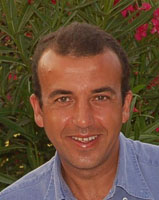 Giuseppe Bianchi is Full Professor of Telecommunications at the School of Engineering of the University of Roma Tor Vergata since January 2007. His research activity, documented in more than 150 papers in peer-refereed international journals and conferences, includes but does not limit to wireless networking, and network privacy and security issues. He has chaired several conferences/workshops, including ACM WMI 2001, ACM WMASH 2003/2004, IEEE QoS-IP 2005, IEEE WoWMoM 2007/2010, IEEE PIMRC 2008. He is (or has been) coordination for the FP6-DISCREET and FP7-FLAVIA projects, and S&T coordinator for the FP7-PRISM and FP7-DEMONS EU projects.
Panelists
- Cecilia Mascolo, University of Cambridge
- Panos Papadimitratos, EPFL Institute of Communication Systems
- Andrea Passarella, Institute for Informatics and Telematics (IIT), National Research Council (CNR)
- Thorsten Strufe, Technische Universität Darmstadt